INFORMS RAS 2026 Problem Solving Competition
Railroad Blocking Problem for North American Class I Railroads — Data Mirror Site
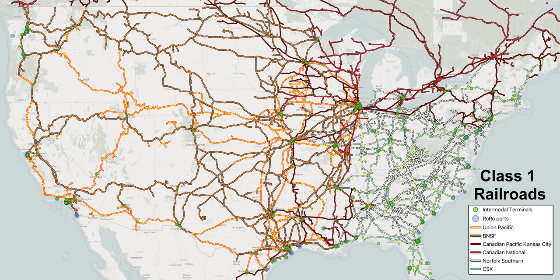
Header image: “US railway map” by Wikideas1, Wikimedia Commons, CC0 1.0 (public domain); own work created with QGIS using U.S. Bureau of Transportation Statistics data. Shown here as an illustrative overview of the Class I railroad network, intermodal terminals, and RoRo ports; it is not the benchmark network.

This is the data mirror site maintained by the ASU Trans+AI Lab for the INFORMS Railway Applications Section (RAS) 2026 Problem Solving Competition. It mirrors the benchmark instances, schemas, validators, scoring tools, and documentation so the dataset stays citable and reproducible. It is not the official competition site: the Kaggle and INFORMS RAS pages linked below are the authoritative sources for the competition itself.
Kaggle competition page INFORMS RAS competition page GitHub repository
Official announcements
- Kaggle — INFORMS RAS 2026 Problem Solving Competition https://www.kaggle.com/competitions/informs-ras-2026-problem-solving-competition The Kaggle competition page is an authoritative source for the competition description, participation information, announcements, and competition materials.
- INFORMS Railway Applications Section — 2026 Problem Solving Competition https://connect.informs.org/railway-applications/new-item3/problem-solving-competition682 The INFORMS Railway Applications Section page is an authoritative source for the competition organization, leadership, timeline, and official RAS information.
Please cite
Peiheng Li and Xuesong (Simon) Zhou. INFORMS RAS 2026 Problem Solving Competition. Kaggle, 2026. https://www.kaggle.com/competitions/informs-ras-2026-problem-solving-competition
@misc{li_zhou_ras2026,
  author       = {Li, Peiheng and Zhou, Xuesong (Simon)},
  title        = {INFORMS RAS 2026 Problem Solving Competition},
  year         = {2026},
  howpublished = {Kaggle},
  url          = {https://www.kaggle.com/competitions/informs-ras-2026-problem-solving-competition}
}
Users relying on upstream public source datasets should additionally cite the applicable original sources, including FAF and OpenStreetMap, as appropriate.
Research benchmark and data provenance notice
RAS2026-PSC is a research-derived and benchmark-calibrated competition dataset created for the INFORMS RAS 2026 Problem Solving Competition. It is not an operational or proprietary railroad dataset. Demand records were developed using transformed Freight Analysis Framework (FAF)-based freight-flow references; users seeking original FAF data should obtain it directly from the official BTS/FAF sources. Physical network connectivity is research-derived in part from OpenStreetMap and additional competition-specific research curation. Applicable OpenStreetMap attribution and ODbL terms remain with OSM-derived components. Benchmark yard definitions, capacities, costs, and other parameters are research abstractions for algorithmic evaluation and should not be interpreted as current railroad operating data. Participants and users take full responsibility and liability for their use of the materials.
Full notice: DATA_PROVENANCE_AND_USE.md · Notices: NOTICE.md
The problem in brief
Railcars are consolidated into blocks at classification yards and travel intact between yards. Given a physical rail network and yard-to-yard commodity demand, participants build a zero-based blocking plan: which blocks to open, the single sequence of blocks each commodity follows, and the physical route of each block. Plans are checked for feasibility (constraints C1–C8) and ranked by total cost (block fixed, transportation, classification handling, interchange), with a volume-weighted Stress Score when full feasibility is unattainable. Three network layers (L1, L2, L3) × three demand multipliers (0.5×, 1.0×, 2.0×) form the nine official cases.
Downloads
Full package — GitHub Release v2.1 Repository ZIP (compressed inputs) SHA-256 checksums
| Item | Location |
|---|---|
Per-layer inputs (node.csv, demand.csv, setting.csv, yard_car_demand_summary.csv, link.csv.zip) |
datasets/l1/, datasets/l2/, datasets/l3/ |
| Yard-to-yard distance matrix | datasets/yard_to_yard_min_distance.csv.zip |
| JSON schemas and CSV validator | datasets/schemas/ |
| Validator, metric notebook, packing scripts, sample solutions | scoring/ |
| Field reference | datasets/DATASET_README.md |
| Scoring reference | scoring/SCORE_README.md |
Quick start:
git clone https://github.com/asu-trans-ai-lab/RAS2026-PSC.git
cd RAS2026-PSC
pip install -r requirements.txt
python unpack.py
python datasets/schemas/validate_csvs.py
cd scoring
python fast_validator_v2_0.py solution_result_l1_10.json --od-matrix od_distance_matrix.csv
Organization team
- Competition Chair — Xuesong Zhou, Professor of Transportation Systems, Arizona State University (xzhou74@asu.edu)
- Co-Chair — Natalia Zuniga Garcia, Computational Transportation Engineer, Argonne National Laboratory (nzuniga@anl.gov)
- Problem Owner — Dr. Peiheng Li, Norfolk Southern Corporation
Institutional affiliations are provided to identify the competition leadership and problem-development roles. Their listing should not be interpreted as a separate institutional license, sponsorship statement, operational endorsement, or transfer of ownership of the released benchmark.
Judging committee
| Name | Organization |
|---|---|
| Cynthia Barnhart | MIT |
| Ravi Ahuja | Optym |
| David Hunt | Oliver Wyman |
| Michael Hewitt | Loyola University Chicago |
| Gunnar Feldmann | Norfolk Southern |
| Edward Lin | Independent / retired Norfolk Southern |
| Clark Cheng | RailTek |
| Marc Meketon | Independent |
| John Fuller | Union Pacific |
| Carl Van Dyke | CVD Zone |
| Baoyu Zhou | Arizona State University |
Affiliations are listed for identification only.
Upstream sources
Freight Analysis Framework (FAF) — U.S. Bureau of Transportation Statistics (BTS); FAF5 developed with support from the Federal Highway Administration (FHWA).
- FAF5 main page: https://www.bts.gov/faf/faf5
- FAF5 Data Tabulation Tool: https://faf.ornl.gov/faf5/dtt_total.aspx
- FAF5.7.1 Regional Database: https://faf.ornl.gov/faf5/data/download_files/FAF5.7.1.zip
- FAF5.7.1 State Database: https://faf.ornl.gov/faf5/data/download_files/FAF5.7.1_State.zip
- Permanent FAF5 dataset DOI: https://doi.org/10.21949/1529116
- Current BTS FAF portal: https://www.bts.gov/faf
FAF5 is listed because it belongs to the provenance family used in developing the RAS 2026 benchmark. The current BTS FAF portal may contain newer FAF generations; do not assume a later FAF release was used unless explicitly documented.
OpenStreetMap (OSM) — © OpenStreetMap contributors, Open Database License (ODbL) 1.0.
- Copyright and license: https://www.openstreetmap.org/copyright
- OSM Foundation License and Legal FAQ: https://osmfoundation.org/wiki/Licence_and_Legal_FAQ
Licenses and notices
Project-authored code is MIT-licensed (LICENSE-CODE); the code license does not extend to the datasets or third-party-derived data, and no blanket data license is asserted. See DATA_PROVENANCE_AND_USE.md and NOTICE.md.
RAS2026-PSC is an openly accessible research benchmark archive for reproducible railroad-blocking algorithm development. It integrates transformed public freight-flow references, open spatial/network references, and competition-specific research curation, while preserving the attribution and use conditions of the underlying sources.